
These little fish move in the water like a snake
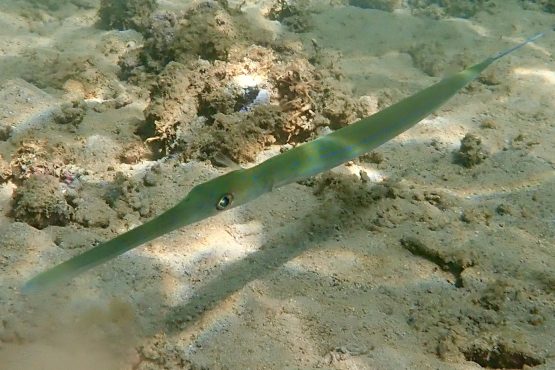
This month Wild Boyz Photography is highlighting the weird and wild side of nature. One of our favorite dive sites to observe weird and wild nature is Blue Heron Bridge near West Palm Beach, Florida. I was lucky to find this tiny fish in the shallow waters. It was only in a few feet of water. Although the shortfin pipefish can be found in very shallow waters, they can also be found deeper than 1,000 feet!
If you are lucky enough to come across a pipefish, they are a very interesting type of fish to observe. Pipefish can be found across the world. There are over 200 species of pipefish. There are even some freshwater species. They are all of a similar body shape to the photographs in this article, however their colors can vary widely. The shortfin pipefish is generally dark brown with a long slender snout. It has pale-colored body bands. Their pattern and coloration aid in their impressive camouflage abilities. This species will grow to around three and a half inches to five and a half inches long. They have large eyes that sit just behind the snout. These eyes are often hard to pick out because they too are camouflaged.

This species of pipefish is considered an uncommon sighting in Florida where I saw this. However, Blue Heron Bridge is known as a good place to locate pipefish and seahorses. Shortfin pipefish live the shallow seagrass beds as well as out on the coral reefs. They are found on the bottom. Some species are found hanging in sargassum floats near the surface. These little fish move in the water like a snake. If a diver approaches them, they tend to stop moving and sit motionless on the seafloor, instinctively relying on their camouflage to protect themselves. Some species can even change color. If the shortfin pipefish feels as though it has been spotted, it will retreat to cover.
If you are wondering how this creature navigates the seafloor, it uses tiny, sometimes translucent, pectoral and dorsal fins. These are often very difficult to see with the naked eye. Pipefish will prey upon benthic creatures such as copepods, amphipods, fish eggs, small juvenile fish, and small crustaceans.
There are over 200 species of pipefish

Did you know?
- Pipefish can range in size from the ~1” pygmy pipedragon to the ~25” brushtail pipefish.
- Like seahorses, female pipefish lay their eggs in the male’s brood pouch. The males fertilize the eggs.
- The earliest evidence for pipefish in the fossil record is from ~50 million years ago! Their bony exoskeleton makes them a good candidate for fossilization.



0 Comments